How to apply and properly use mosquito repellent sticks?

An anti-mosquito repellent stick is not used like a cream or spray. The goal is not to slather it on your skin, but to apply the product to the right spots, in sufficient quantities, without getting it everywhere.

The solid format has a real advantage: it applies directly to the skin, it doesn't evaporate into the air, it doesn't leak in your bag, and it allows you to target exposed areas. But for it to be pleasant and effective, you need to use it correctly. Nothing too complicated, but a few things to know that we'll detail for you here.
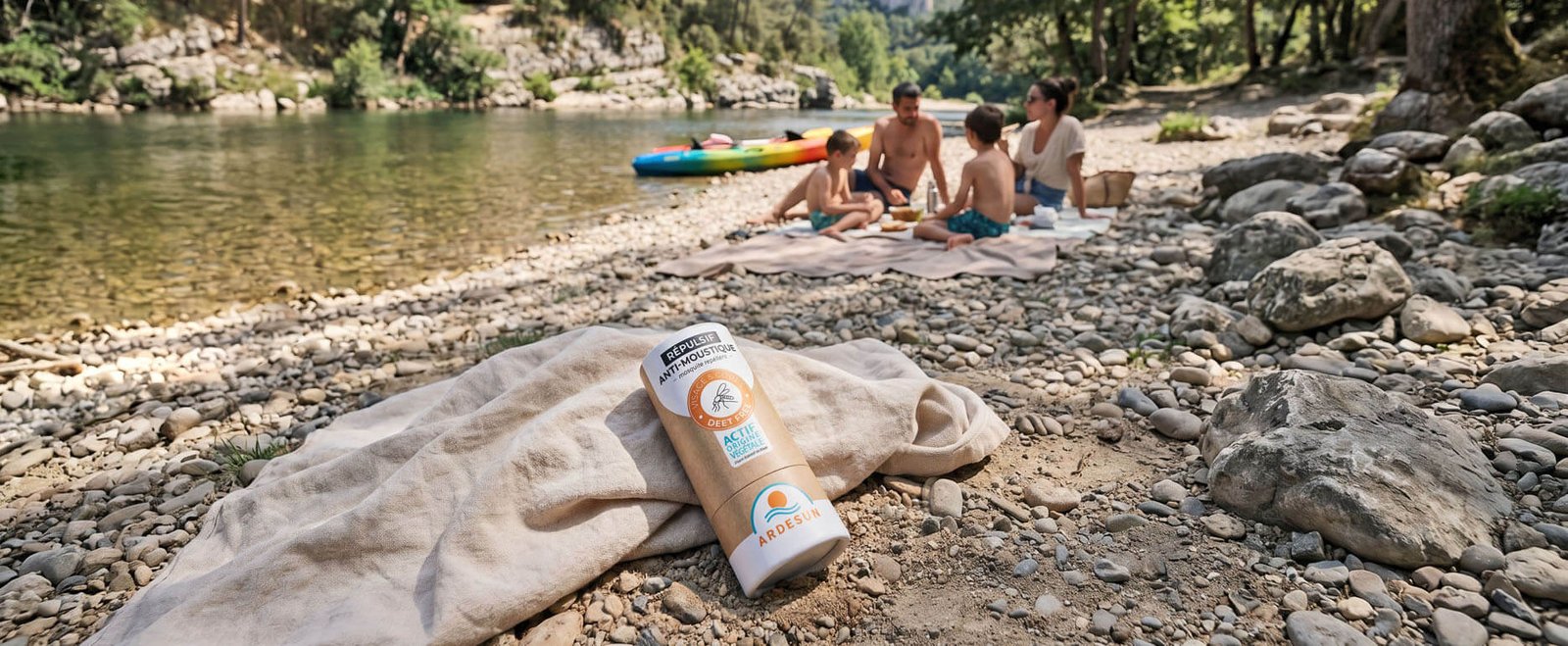
ARDESUN solid mosquito repellent stick, placed outdoors near a river

The right method: a little product, but in the right place

With a repellent stick, the correct technique is simple: gently push the bottom of the tube, let out very little product, then apply to exposed areas.

No need to stick out the stick 3 cm. The more the stick is extended, the more fragile it becomes, especially in summer. One or two millimeters are more than enough to maintain a clean swipe and avoid breaking the product.

For a mosquito repellent, you can apply the product in several small, spaced-out passes or dots, then lightly smooth if needed. This isn't sunscreen: you're not trying to cover every millimeter of skin with a uniform layer. You're primarily trying to create a repellent presence on exposed areas and areas where mosquitoes tend to bite.

If mosquitoes continue to come into contact, you should reapply, especially on the ankles, wrists, neck, or the backs of the knees.

  • Dispense only a very small amount of product.
  • Apply to exposed skin areas.
  • Make a few short strokes or small, spaced-out stitches.
  • Focus on the ankles, wrists, neck, elbows, and backs of the knees.
  • Avoid eyes, mouth, mucous membranes, and hands of young children.
  • Wash hands after use.
  • Reapply as needed, depending on sun exposure, perspiration, and the product's instructions.
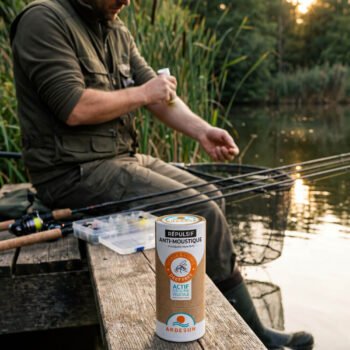
ARDESUN mosquito repellent stick used during a fishing trip by the water

Where to apply mosquito repellent stick?

Mosquitoes don't just bite where the product smells strongest. They detect heat, moisture, CO₂, body odors, and easily accessible areas. In practice, some parts of the body are often forgotten even though they are very exposed.

Anchors

This is one of the most forgotten areas. When on a terrace, wearing shorts or sandals, your ankles are very exposed.

Wrists and forearms

A few short passages suffice. However, avoid the palms and fingers of young children.

Nape and Neck

Ideal for use while hiking, in the garden, or in the evening. Apply sparingly, avoiding the area around the mouth.

Back of the knees

When wearing shorts or a dress, this area quickly attracts bites and deserves a quick pass.

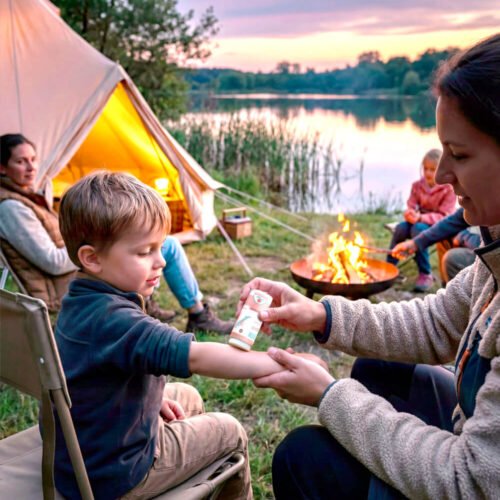
Applying ARDESUN mosquito repellent stick to a child while camping by the water

On the face, you don't just apply the stick randomly.

The face requires extra care. Apply the stick directly to exposed areas using short, light strokes, avoiding the eyes, mouth, and mucous membranes. There’s no need to get too close: it’s better to apply it a little more broadly to the upper neck, temples, or the contours of the face, without touching sensitive areas.

For young children, the product should be applied by an adult. Avoid applying it to the hands, because children often put their hands in their eyes or mouths. Also avoid applying it to irritated areas, scrapes, scratched pimples, and skin that is already sensitive from sunburn.

A stick is convenient for the face because it doesn't spray product into the air. That's one of its major advantages over a spray. But that doesn't mean you don't need to apply it carefully.

Common Mistakes When Using a Stick-Type Repellent

Put it on under your clothes

A skin repellent should be applied first to exposed areas. When applied under clothing, it is less effective and may rub against and unnecessarily stain the fabric.

Spread it like cream

For a repellent, a thick layer isn't necessarily more effective. It wastes the product and can make the skin feel less pleasant.

Forget the ankles

That’s often where the mosquitoes get the upper hand. Just a quick swipe over your ankles and lower legs makes a big difference.

Apply to irritated skin

Avoid cuts, wounds, scratched pimples, burns, sunburn, and sensitive areas.

Leave the stick in direct sunlight

A solid stick can soften with heat. It's best to keep it in the shade, in a bag or a pocket at a moderate temperature.

Confusing repellent and treatment

A repellent helps keep mosquitoes away. It does not replace covering clothing, bed nets, or good habits in a heavily infested area.

Sun, then repellent

When using sunscreen and mosquito repellent, the order matters.

Sunscreen must be applied first, generously and evenly to all areas exposed to the sun. The sunscreen film is then allowed to settle, after which the repellent is applied on top, only to the necessary areas.

This is also why a “2 in 1” sunscreen and mosquito repellent product is not always a good idea: sunscreen must be reapplied often and in large amounts, whereas a repellent must be used according to its own instructions. The two uses do not follow the exact same logic.

Apply the sunscreen first.
Allow time for the sunscreen to distribute evenly.
Then apply the repellent stick to exposed areas.
Reapply sunscreen after swimming, sweating, or towel drying.
Reapply the repellent only if necessary and according to the product precautions.
Never replace sunscreen with a repellent.

Why choose a mosquito repellent stick?

The stick isn't just a “different” format. It truly changes the way you apply the product, especially when you're outside, with kids, a bag, wind, sand, or when your hands are already full.

01

No spray cloud

The product goes on the skin, not in the air. It is more comfortable near the face, at the table, or when it is windy.

02

Less waste

It is applied wherever you want, without losing half of the product around you or on your clothes.

03

Clean transport

No leaks in the bag, no spilling bottles, no wet or sticky cap after application.

04

Precise application

Ankles, wrists, back of the neck, back of the knees: the stick makes it easy to quickly target areas that are often bitten.

The limits of the stick compared to a spray

The stick has many advantages, but it is not perfect in all situations.

On a large skin area, a spray or a fluid lotion can be faster. To apply it to the back, you often need someone's help. And in very hot weather, a solid stick can soften if left in a car or in direct sunlight.

Another point: the stick is applied directly to the skin. For family use, it's best to avoid applying it to irritated skin, clean the top if necessary, and avoid sharing it indiscriminately if someone has a skin lesion.

The right choice therefore depends on the use. For an evening, a walk, a hike, a beach bag, or a family kit, the stick is very practical. To quickly cover several people over large areas, a liquid format can be faster.

  • Stick : precise, clean, compact, spray-free, ideal for targeted areas.
  • Spray fast on large surfaces, but more scattered and more product loss.
  • Lotion or roll-on: Good compromise, but risk of leaking depending on the container.
  • Jar balm inexpensive, but requires putting your fingers in the product.

A repellent does not replace other forms of protection

When mosquitoes are very prevalent, skin repellent is not enough. Long, loose, light-colored clothing, mosquito nets, ventilated areas, and the elimination of stagnant water remain complementary measures.

This is particularly true of the tiger mosquito, which is active during the day, often around homes, and capable of biting multiple times. The idea is not to empty a bottle onto the skin, but to combine the right habits: covering what can be covered, applying the repellent to what remains exposed, and then reapplying only if necessary.

A solid format designed for outdoor outings

The ARDESUN anti-mosquito repellent stick was designed for direct, clean and targeted application. It is formulated without DEET, without alcohol, with an active substance of plant origin derived from eucalyptus citriodora, in a recyclable cardboard case.

It slips easily into a hiking backpack, a vacation toiletry bag, a picnic basket, or a jacket pocket. It is precisely the type of product you prefer to have on hand before mosquitoes ruin the evening.

Canoeing in the Ardèche Gorges, illustrating the outdoor activities for which ARDESUN designs its sun and mosquito protections.

Frequently asked questions about using an anti-mosquito repellent stick

Should you apply a repellent stick all over your skin?

Not necessarily like a sunscreen. For a mosquito repellent, the goal is to apply the product to exposed areas and areas that are frequently bitten. A few short strokes or spaced-out dots may be enough for everyday use. If the mosquitoes continue to bite, the application must be reapplied.

Can you apply a repellent stick to your face?

Yes, if the product is intended for this use, but with caution. The stick can be applied directly in small strokes on areas away from the eyes and mouth: upper neck, temples, or around the face. Avoid the eyes, lips, mucous membranes, and irritated areas.

Can it be used on children?

Always follow the product labeling. For young children, application must be done by an adult. Avoid hands, eyes, mouth, mucous membranes, and areas of irritated skin.

How often should the application be renewed?

You must follow the product instructions. In practice, you can reapply if mosquitoes come into contact again, after heavy sweating, or after significant rubbing. There is no need to reapply constantly if the protection remains sufficient.

Is the stick more effective than a spray?

Not automatically. Effectiveness depends mainly on the formula, the active ingredient, the amount applied, and following the instructions for use. The stick is mainly more precise, cleaner, and easier to carry. The spray can be faster on large surfaces.

Should you apply insect repellent before or after sunscreen?

Sunscreen goes on first. The repellent is applied next, once the sunscreen is well distributed on the skin. Both products must be reapplied according to their own instructions.

Can a solid stick melt?

It can soften if left for a long time in direct sunlight, in a hot car, or near a heat source. It is best to keep it away from excessive heat.

Sources & Precautions

An insect repellent is a biocidal product: it must be used in accordance with the precautions indicated on the label. The advice in this article does not replace the product's instructions for use.

To complete mosquito protection, health authorities also recommend long, loose, and light-colored clothing, bed nets, and reducing stagnant water around homes.

Discover the ARDESUN mosquito repellent stick

Shipping costs OFFERS from any order of €35 including tax in metropolitan France